My Blog
AskDrPeering
Ask Dr. Peering

Ask Dr. Peering





Q: DrPeering -
Do you have a list of the top internet exchange points in the top five or six U.S. metros? Do you believe the top exchange points can be replicated by a new entrant or is the critical mass and resulting network impacts among customer ecosystems too strong? Will all the future internet traffic (video traffic) flow through the top existing exchange points or, over time, there is the possibility for new exchange points?
Thanks.
Kevin
A:
Kevin - thanks for the question.
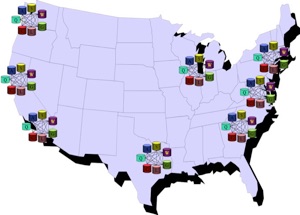
I worked closely with the Tier 1 ISPs to learn that there are essentially 8 “interconnect regions” across the U.S.
The 8 U.S. Interconnect Regions
-
1.Seattle
-
2.San Francisco Bay Area
-
3.Los Angeles
-
4.Chicago
-
5.Dallas
-
6.New York City area
-
7.Washington DC area
-
8.Atlanta
The dominant Internet Exchange Points are the Equinix facilities for each region except for
Seattle (where the SIX pretty much rules the roost),
Los Angeles which is pretty much around 1 Wilshire and CoreSite (thanks Eric Bell for pointing this out),
Atlanta (where it is TelX who acquired Michael Lucking’s AtlantaIX at 56 Marietta Street), and
the New York City area where there is an oligopoly of competing IXes around 60 Hudson, 111 Eighth, 25 & 75 Broadway, in NJ Halsey street, etc. Check out this data center map.
The Washington DC area is pretty much Equinix Ashburn. There used to be Switch & Data competing in each of the 8 U.S. interconnection regions, and in practice leading the Bay Area market, but they are now absorbed into Equinix. The word in the field is that these are still operated as separate entities but are slowly consolidating.
In each Internet Peering Ecosystem that I studied, there is generally the same thing - there is usually a dominant IX and maybe a competitor or two in the metro market.
Can these top exchange points be replicated?
It is possible to displace an incumbent IX operator, but very difficult.
I documented the early Equinix vs. MAE-East struggles in “How Equinix beat MAE-East : IX Playbook tactics 8-11” and more broadly in “the Art of Peering : The IX Playbook” . From a decade of research I documented the many tactics used to beat the large incumbent IXes -- these clever tricks is one of the more popular and fun discussions in the peering workshops.
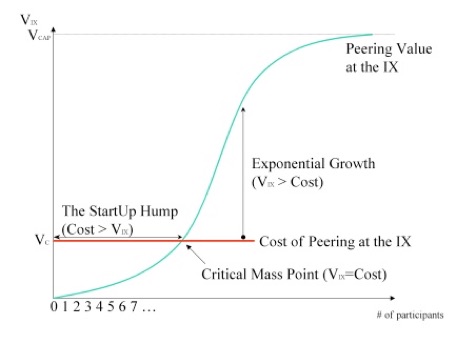
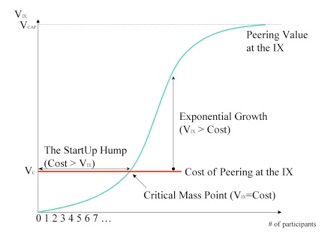
The challenge can be summed up with the graph below where we plot the value of the Internet Exchange point (or colocation facility) over the number of participants.
Every IX and colo starts out with few or no customers. The value of a colocation facility is proportional to who else is there. So how does a challenger attract those first few customers when there is noone to interconnect with? This is a challenge that seasoned IX operators and colocation providers are well versed in. The good news is that there are in fact tricks of the trade to build the critical mass.
The IX has to do whatever is necessary to get to critical mass so the value or participating is greater than the cost of getting in. This period is called the “startup hump.”
Once critical mass is reached, the IX can experience an exponential growth in value. Why exponential? The reason for the exponential growth in value is that n participants can interact with n-1 other participants. The aggregate value of the IX then rises to n(n-1)/2 and the customer can financially justify building in.
The problem with competing against the big colos and IXes is that the value is so high there that it will be very difficult to lure away the new players (who want to peer with the established guard), and even more difficult to lure the established guard away from a place where they derive much value. There are ways of doing both of these things, but there is a bigger problem.
In my experience, the companies that could execute maneuvers against the dominant IXes need to migrate from building racks and selling power to building a population and facilitating the interconnection. Beyond education and an inclination, there is an subtle art to building and maintaining a critical mass or participants, and once obtained it is enormously valuable and protected. So the challenger will require a culture shift, experienced personnel, patience, lots of travel and investment, and a skilled strategic sales team. The payback won’t be immediate, I promise you. But it tends to be long lasting if this is the strategic focus and a long term sustainable differentiator. Those engaged in commodity colo trench warfare need this to command a premium and a profit.
Your last question is about trends and shifts and the impact on the the future of IXes.
History has taught us whenever there are major changes in the ecosystem, there is an opportunity to exploit. The requirements for video traffic and the domination of this traffic type opens up the possibility for a digital media Internet Exchange that may or may not be colocated at the dominant IXes in the U.S. It is possible that an agile new player could leverage this opportunity and make the 8 interconnect regions insignificant in comparison in the next wave of evolution of the Internet Peering Ecosystem.
Another possible future comes out of a couple questions:
“How many IXes are needed in each interconnect region?”
and
“At what point will Switch and Data and Equinix be considered one IX?”
It is possible, but far from certain that the peering community says that they need a second IX
-
•for redundancy,
-
•one run by a different operator,
-
•with different security systems,
-
•different operating procedures and
-
•different peering hardware,
-
•with different ...
At that point, the market emerges for an agile startup IX to become number 2 in the Equinix dominated markets. See :How many IXes per metro for a discussion of the study that showed that ISPs wanted only 1 or 2 IXes per metro and the 9 selection croteria for an IX.

The 8 interconnect regions in the U.S.
Next Generation Exchange Points?
January 26, 2011

The 2014 Internet Peering Playbook
In Print
and for the Kindle:
The PDF, ePub and
.mobi files are
also available as a
perpetually updated
DropBox share:
Price: $9.99
and in French!
The 2013 Internet Peering Playbook
also available for the Kindle:
and the ipad