My Blog
AskDrPeering
Ask Dr. Peering

Ask Dr. Peering





Q: DrPeering -
I read in your book that you model the Internet in each country as an autonomous “Internet Peering Ecosystem.” I am not so sure that is an apt analogy. In ecosystems you have predators and a prey that interact as a system, a cycle of life. I don’t see such a thing in the Internet Peering ecosystem.
Ahogo Dahadat
A:
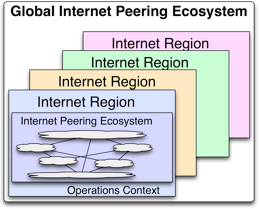
Thanks for reading the book! And yes, I model each Internet Region (usually bounded by country boundaries) as an independent ecosystem, each with its own critters operating its own habitat. Each habitat is a little bit different, with different:
- Tier 1 ISPs
- Tier 2 ISPs
- Internet Exchange Points
-
-transit prices
-
-transport prices
-
-etc.
Each ecosystem has its own peering community, with their own quirks and preferences and obstacles to peering. In every case, the cost of local loops is different leading to a different break-even analysis. So systematically, they are each independent of one another.
It is also true that these players do not exactly eat each other, but similar players do hunt (compete) for resources, get consumed (acquired), go extinct (bankrupt), and excrete old resources (network gear and systems) <fill in your own joke here.>, etc. The key is the mutual interdependence in the ecosystem, the interactions and positional power as analogous to the activities and place of the participants in the traditional ecology notion of ecosystems.
Q: DrPeering -
Do ISPs ever buy transit from others in one ecosystem and peer with those same parties in another ecosystem?
Mr. Bun E. Carlos
A:
Thanks for the question. I documented this in The Internet Peering Playbook as Tactic 4. Bundle Internet Transit with Peering - some ISP peering coordinators considered it a cheap trick and more trouble than it was worth.
Tactic 4. Bundle Internet Transit with Peering
The beauty of this approach is that the internal advocate handles all internal hurdles to peering, the peering can be executed immediately, and using separate interface cards makes it easy to implement.
The more common way I see this is when an ISP splits their network into a couple of independent Autonomous Systems (ASes) and they peer them independently - an AS for Asia, one for the US and one for Europe for example. Then the peering decisions are independent and non-transitive, so peering in Asia isn’t giving away your network routes in the U.S. for example.
These two questions are related in a way - they bring up a possible emerging trend. Some of my consulting with clients is highlighting that Asia itself may becoming a singular “Internet Region” - with its own “Asia Tier 1 club.” If true then this is new and interesting, because no single government can apply pressure to this group to get them to peer more openly, or document their peering practices, etc. as governments have when all Tier 1 ISPs interconnect within the confines of a single country.
This is an emerging trend that we should keep an eye on!

Internet Peering Ecosystems are discussed..
What is an Internet Peering Ecosystem?
November 22, 2011

The 2014 Internet Peering Playbook
In Print
and for the Kindle:
The PDF, ePub and
.mobi files are
also available as a
perpetually updated
DropBox share:
Price: $9.99
and in French!
The 2013 Internet Peering Playbook
also available for the Kindle:
and the ipad