My Blog
AskDrPeering
Ask Dr. Peering

Ask Dr. Peering





Q: DrPeering -
Where did this 95th percentile thing come from?
Unlucky Michael
A:
(excerpts from The Internet Peering Playbook)
The Origin of the 95th Percentile Measurement
The Internet Transit pricing model went through three distinct pricing paradigms.
Internet Transit sold by access capacity. In the early Internet days, Internet Transit was charged on a circuit capacity basis. You would purchase a T1 circuit (1.544 Mbps) to the Internet and pay as if you used the entire capacity of the circuit 24 hours a day. But if you didn’t use very much of this capacity, you were still paying as if you did. At the time, this made Internet Transit tough to sell to some low volume prospects.
Internet Transit sold by average usage. One of the early ISP pioneers started charging based on average use, but this measure ended up being skewed by the general “burstiness” associated with Internet traffic. Customers that used only a little transit were paying as if they used much more because the average was skewed upwards by these bursty outliers.
Internet Transit sold by 95/5 model. To address this, one ISP adopted the 95th percentile measure that was primarily introduced to not overly punish a customer for the occasional spikes in traffic volume, and still allow the ISP to bill based the load placed on its network. This approach seemed palatable to the market and sold well. The rest of the industry followed suit and within a year or so 95/5 was the dominant form of pricing for the Internet Transit service.
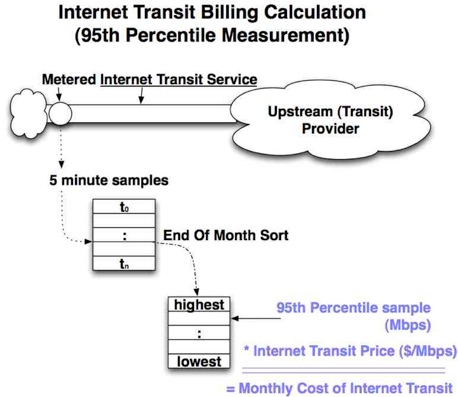
The 95th percentile measurement process is typically a three-step process as follows (and diagramed above).
1.Every five minutes the meter on the service is sampled.
2.The delta is calculated between the two adjacent samples and the result is stored. (It is in this step that corrections are made for wrapping counters, counter resets from reboots, anomalies in the measurement on the metering device, etc.)
3.At the end of the month, the five-minute-deltas are converted to Mbps and stacked lowest to highest. It is the 95th percentile value that is used to calculate the traffic volume for the month.

Metered Internet Transit metered typically uses the 95th percentile measurement methodology to determine the volume that is billed. (Some offer flat rate, but 95/5 is the norm.)
The Origins of 95/5
April 29, 2011

The 2014 Internet Peering Playbook
In Print
and for the Kindle:
The PDF, ePub and
.mobi files are
also available as a
perpetually updated
DropBox share:
Price: $9.99
and in French!
The 2013 Internet Peering Playbook
also available for the Kindle:
and the ipad